
15 PCB Manufacturers to Know in 2026: Selection Guide
Short answer: there is no single best PCB manufacturer for every design. A fabricator that is strong in high-volume HDI may be the wrong fit for a five-board prototype, while a fast online prototype service may not provide the qualification, traceability, controlled processes, or transfer plan required for automotive, aerospace, medical, or long-life industrial production.
This 2026 guide compares 15 PCB manufacturers by the work they publicly say they support: high-density interconnect (HDI), IC substrates, rigid-flex, RF and microwave, high-layer-count boards, rapid prototypes, small series, assembly, and global volume production. It is designed to help engineers and buyers build a shortlist, not to declare an unsupported winner.
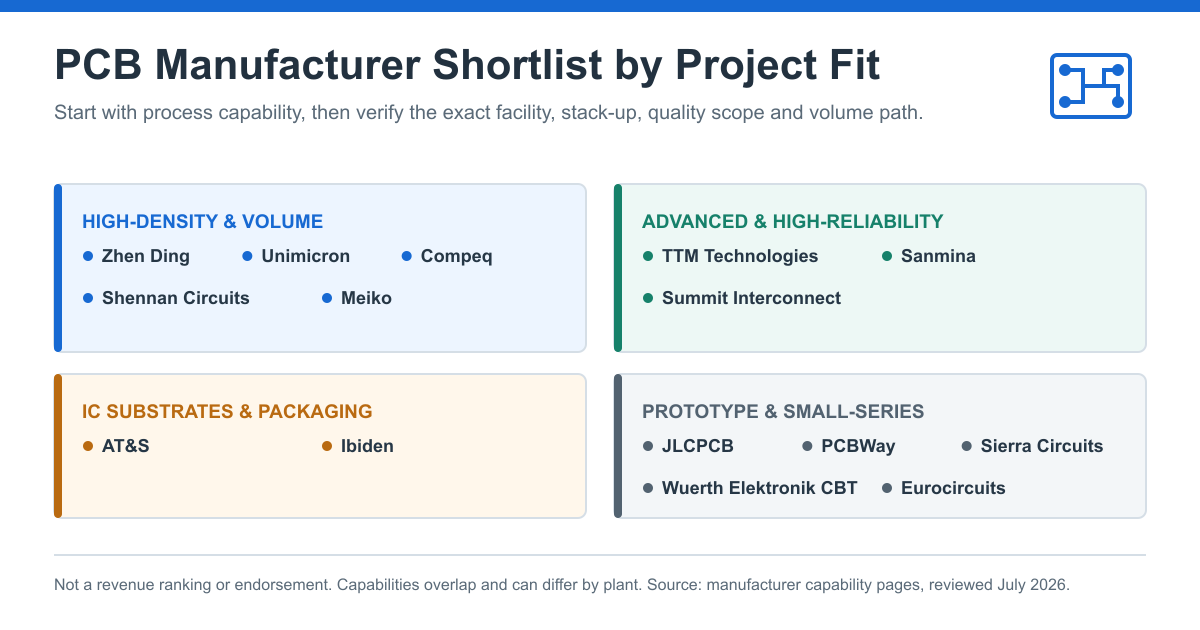
Figure 1. A capability-based starting point for a PCB manufacturer shortlist. Original illustration by Dasenic.
PCB Manufacturer Comparison at a Glance
| Manufacturer | Useful starting point | Publicly listed PCB scope |
|---|---|---|
| Zhen Ding Technology | High-density and volume programs | FPC, SLP, HDI, rigid, IC substrates, rigid-flex, modules |
| Unimicron | HDI, flexible circuits and IC carriers | PCB, HDI, FPC, rigid-flex, carriers and IC services |
| TTM Technologies | Advanced multi-technology programs | Rigid, HDI, flex, rigid-flex, backplanes, RF/microwave, thermal |
| Compeq | Multilayer, HDI and mobile applications | Multilayer, HDI, high-layer-count, FPC, rigid-flex, SMT |
| AT&S | High-end PCBs and IC substrates | High-density PCBs, substrates and packaging-related solutions |
| Shennan Circuits | PCB, substrate and assembly integration | Printed circuit boards, packaging substrates and electronic assembly |
| Ibiden | Advanced IC package substrates | High-performance package substrates for advanced computing devices |
| Meiko Electronics | Broad PCB technologies plus EMS | Multilayer, HDI, flex, rigid-flex, high-current, thermal, embedded |
| Sanmina | High-speed and mission-critical boards | High-layer-count PCB, backplane, HDI, flex, rigid-flex, quick-turn and volume |
| JLCPCB | Online prototypes and production | Rigid, flex, rigid-flex, high-frequency, metal-core and assembly options |
| PCBWay | Online prototypes and specialist builds | Standard and advanced rigid, flex, rigid-flex, HDI, RF and assembly |
| Sierra Circuits | US quick-turn and engineering support | Rigid, HDI, flex, rigid-flex, RF and PCB assembly |
| Summit Interconnect | Complex quick-turn and high-reliability work | Rigid/HDI, flex/rigid-flex, RF/microwave, thermal and assembly |
| Wuerth Elektronik CBT | European engineering-led projects | Basic, flex/rigid-flex, HDI microvia, embedding and thermal concepts |
| Eurocircuits | European prototypes and small series | Standard, HDI, RF, impedance, semi-flex, IMS and assembly services |
Global and Advanced PCB Manufacturing Shortlist
1. Zhen Ding Technology
Zhen Ding presents itself as a one-stop PCB solutions provider. Its official product portfolio spans flexible printed circuits, substrate-like PCBs, HDI, rigid boards, IC substrates, rigid-flex, and modules. That range makes it relevant when an OEM needs several interconnect technologies across compact consumer, computing, communications, automotive, or related product families. A buyer should still identify the plant, process window, and production geography assigned to the specific program.
2. Unimicron
Unimicron's official product description lists conventional PCB, HDI PCB, flexible printed circuits, rigid-flex, carriers, and IC test and burn-in services. It is therefore a logical company to evaluate for dense mobile and computing boards, flexible interconnect, and package-substrate programs. Do not assume that every Unimicron site supports every listed process; use the group's plant and sales contacts to confirm the actual manufacturing route.
3. TTM Technologies
TTM's PCB solutions page covers conventional and HDI rigid boards, flex and rigid-flex, backplanes, substrate-like PCBs, RF and microwave technology, and thermal management. This breadth is useful for programs that combine signal integrity, high reliability, unusual materials, or multiple board technologies. Qualification should focus on the facility that owns the required process and on the certifications that apply to that location, not just the corporate brand.
4. Compeq
Compeq's official corporate materials describe a portfolio of general multilayer PCB, HDI, high-layer-count PCB, flexible circuits, rigid-flex, and optional surface-mount services. Its product area is a starting point for buyers evaluating dense computing, communications, mobile, automotive, or consumer platforms. Ask for a current capability matrix and approved material list because broad product categories do not by themselves define line width, via structures, reliability class, or volume readiness.
5. AT&S
AT&S focuses on high-end PCBs and advanced IC substrates. The company's official solutions overview connects these technologies to automotive, aerospace, industrial, medical, communications, and computing applications. It belongs on a shortlist when miniaturization, high-density interconnect, advanced packaging, or demanding reliability drives the design. Buyers should confirm whether the need is a PCB, an IC substrate, or a combined packaging solution before sending an RFQ.
6. Shennan Circuits
Shennan Circuits, also known as SCC, states that its business covers printed circuit boards, packaging substrates, and electronic assembly. Its official company profile also describes manufacturing locations in Shenzhen, Wuxi, and Nantong. That integrated scope can be useful for customers seeking PCB fabrication with a path toward substrate or assembly services. The RFQ should specify which stage SCC will own and which quality documents must follow the product.
7. Ibiden
Ibiden is best evaluated as a specialist in advanced IC package substrates rather than as a general online PCB shop. Its 2025 integrated report emphasizes high-performance package substrates for advanced computing, including server applications. Designers working around high-end CPUs, GPUs, accelerators, and package-level interconnect may find that expertise relevant. Ordinary two-layer prototypes or low-complexity industrial boards are a different purchasing problem and need a different supplier model.
8. Meiko Electronics
Meiko's official product portfolio includes double-sided and multilayer boards, HDI, flexible and rigid-flex circuits, high-current boards, heat-dissipation structures, and embedded-device technology. The company also lists EMS and assembly services. This combination is relevant to automotive, industrial, power, and compact electronics where thermal or current performance matters alongside interconnect density. Confirm the design rules and reliability evidence for the exact construction rather than relying on the category name.
9. Sanmina
Sanmina's PCB manufacturing page lists high-speed boards, backplanes, HDI, multiple sequential laminations, flex circuits, quick-turn prototypes, and global volume manufacturing. It also publishes capabilities for mission-critical and very high-layer-count work. This makes Sanmina relevant for communications infrastructure, data center, aerospace, defense, medical, industrial, and test systems. The company is not the same as APCT; each supplier must be linked and qualified under its own identity.
Prototype, Quick-Turn and Engineering-Led Shortlist
10. JLCPCB
JLCPCB is commonly evaluated for online quoting, prototypes, assembly, and repeat production. Its current capability page lists rigid, flexible, rigid-flex, high-frequency, and metal-core options in addition to standard multilayer work. The online workflow is useful when speed and cost transparency matter, but unusual stack-ups, controlled materials, regulated products, or a future high-volume transfer require direct engineering confirmation before the first order.
11. PCBWay
PCBWay publishes separate standard and advanced capability areas covering rigid boards, flex and rigid-flex, HDI, high-frequency materials, metal-core designs, and assembly. Its standard PCB capability table gives concrete limits for materials, copper, dimensions, thickness, line width, drilling, and finishes. Use the relevant advanced page for nonstandard work and obtain written confirmation for every requirement that falls near a published limit.
12. Sierra Circuits
Sierra Circuits positions its US operation around quick-turn PCB fabrication and assembly with engineering support. Its official products page covers rigid, HDI, flex, rigid-flex, RF/microwave, and assembly services. It can be a useful starting point for North American NPI, complex prototypes, and programs that benefit from close DFM communication. Buyers planning volume production should define whether Sierra will build production or support a controlled transfer to another qualified source.
13. Summit Interconnect
Summit offers quick-turn and production services for rigid and HDI, flex and rigid-flex, RF/microwave, thermal designs, and assembly. Its detailed manufacturing capability table separates standard, advanced, and emerging limits for layers, drilling, trace geometry, vias, finishes, testing, and quality. That transparency is valuable for complex US-based and high-reliability work. The final quote should still identify the building facility and approved process route.
14. Wuerth Elektronik CBT
Wuerth Elektronik Circuit Board Technology provides an engineering-oriented European portfolio. Its official PCB overview covers basic boards, flexible and rigid-flex designs, HDI microvia, embedding, thermal management, and printed-polymer concepts. This makes it useful when early technical consultation and a broad technology menu matter. Confirm production location, lead time, documentation package, and lifecycle support for the selected technology.
15. Eurocircuits
Eurocircuits focuses on prototypes and small series produced in its own European facilities. Its service portfolio includes standard multilayer, HDI, defined impedance, RF, semi-flex, insulated metal substrate, and assembly options. Online DFM and pooling can make standard work efficient, while the published scope helps show where a design moves outside the service model. It is a better fit for prototype and small-series needs than for every high-volume production program.
How to Choose a PCB Manufacturer
1. Define the board before comparing suppliers
A quote cannot be compared fairly until the build requirements are stable. Record the layer count, finished thickness, copper weights, material family, glass transition temperature, controlled-impedance targets, minimum trace and space, minimum mechanical and laser drill, via types, sequential lamination count, surface finish, solder mask, panel constraints, acceptable substitutions, and annual volume. Include the IPC class and any customer-specific acceptance criteria.
2. Qualify the exact plant, not only the brand
Large PCB groups operate multiple facilities, and a certification at one plant does not automatically cover another. Request current certificates with the site address and scope. For regulated work, check the edition, expiration, exclusions, and relationship between the quoting entity and manufacturing entity. Ask where drilling, lamination, plating, imaging, electrical test, microsection, and final inspection will occur, including any subcontracted steps.
3. Separate prototype success from production readiness
A prototype can pass even when its construction is too expensive or unstable for volume. Before design freeze, obtain the proposed production stack-up, material sources, panelization, coupon plan, process capability, yield assumptions, and transfer procedure. If prototypes and production will use different factories, define which data, tooling, impedance models, approvals, and golden samples move between them.
4. Evaluate DFM quality, not just quote speed
A useful DFM review explains the risk and proposes a controlled correction. It should flag annular ring, drill-to-copper spacing, solder-mask dams, copper balance, impedance geometry, material availability, stack-up symmetry, via reliability, rout tolerances, panel rails, test access, and assembly interactions. Avoid approving silent edits to Gerber or ODB++ data. Every change should be documented and accepted through revision control.
5. Specify testing and traceability
State whether the order requires 100% electrical test, automated optical inspection, impedance coupons and TDR results, microsections, ionic cleanliness, solderability, X-ray, first-article inspection, material certificates, certificate of conformance, date or lot traceability, and retained samples. For high-reliability work, define acceptance limits and sample sizes instead of asking only for "full testing."
6. Compare total landed and lifecycle cost
Unit price is only one line. Include engineering charges, tooling, test fixtures, coupons, panel utilization, minimum order quantity, yield-related charges, expedited fees, freight, duties, payment terms, inventory exposure, requalification cost, and the cost of a missed launch. Also ask how the supplier handles process-change notifications, material discontinuation, tooling retention, data retention, and repeat builds several years later.
PCB RFQ Checklist
- Gerber, ODB++, IPC-2581, or native package agreed with the supplier.
- Fabrication drawing with dimensions, tolerances, board outline, holes, slots, cutouts, and edge requirements.
- Layer stack-up, copper weights, controlled impedances, and allowed material equivalents.
- Via construction: through, blind, buried, microvia, stacked or staggered, filled, capped, and backdrilled.
- Surface finish, solder mask, legend, peelable mask, carbon, edge plating, or other special processes.
- Panelization, breakaway method, tooling holes, fiducials, assembly rails, and array drawing.
- Prototype quantity, pilot quantity, annual volume, target lead time, and production ramp schedule.
- Required quality standard, facility certifications, inspection records, test reports, and traceability.
- Approved revision, deviation approval process, engineering-contact details, and confidentiality needs.
- Delivery address, Incoterms, packaging, moisture protection, shelf-life marking, and export requirements.
Coordinate PCB Fabrication with Component Supply
A bare-board delivery date is not the same as a build-ready assembly date. Long-lead or end-of-life semiconductors, connectors, memory, power modules, and passives can stop the assembly even when the PCB arrives on time. Freeze the manufacturer part numbers, approved alternates, and component packaging requirements while the board is still in DFM.
For component planning, use Dasenic's manufacturer directory, upload a parts list through the BOM service, or send specification-locked and hard-to-find requirements through the RFQ page. Keep the PCB revision, BOM revision, and approved vendor list synchronized so that a substitute component does not create an unreviewed footprint, thermal, voltage, or lifecycle change.
Frequently Asked Questions
Which company is the world's largest PCB manufacturer?
That answer depends on the reporting year, exchange rate, corporate scope, and whether the source counts only bare PCBs or also substrates, modules, and assembly. This article intentionally does not reproduce an unaudited revenue ranking. For sourcing, the more useful question is which qualified facility can repeatedly build your exact construction at the required volume and quality level.
What is the difference between a PCB and a PCBA manufacturer?
A PCB fabricator makes the bare printed circuit board. A PCBA provider places and solders components onto it and may add inspection, programming, functional test, cable, enclosure, and box-build services. Some companies perform both, while others coordinate partner factories. Define ownership of material sourcing, incoming inspection, workmanship, testing, and warranty before placing the order.
Should I use one supplier for prototype and production?
It can reduce transfer risk when one supplier is competitive at both stages, but it is not always the best commercial fit. If a different production plant is planned, design that transfer before the prototype: align materials, stack-up, process limits, test coupons, data formats, and acceptance criteria. A successful prototype from a different process is not automatic proof of production readiness.
How many PCB manufacturers should receive an RFQ?
Start with three to five suppliers whose published capabilities match the board. Too many unqualified quotes waste engineering time and produce misleading price comparisons. Use the same controlled RFQ package for each supplier, record every approved deviation, and compare technical response quality, manufacturing route, documentation, lead time, and total cost alongside price.
Review note: Manufacturer capabilities and service limits can change. The linked first-party pages were reviewed on July 17, 2026. The latest written quotation, capability matrix, plant certificate, and approved fabrication drawing take precedence over this general guide.