
CR2032 vs CR2450: Size, Capacity and Interchangeability
CR2032 and CR2450 are usually not interchangeable. Both are nominal 3V, non-rechargeable lithium coin cells, but CR2032 is 20.0mm wide and 3.2mm thick, while CR2450 is 24.5mm wide and 5.0mm thick. Choose the size specified by your device, not simply the cell with more capacity.
This comparison covers physical fit, capacity, current requirements and replacement checks. The numeric examples below refer to Panasonic's standard models; the exact manufacturer part number and terminal style remain important.
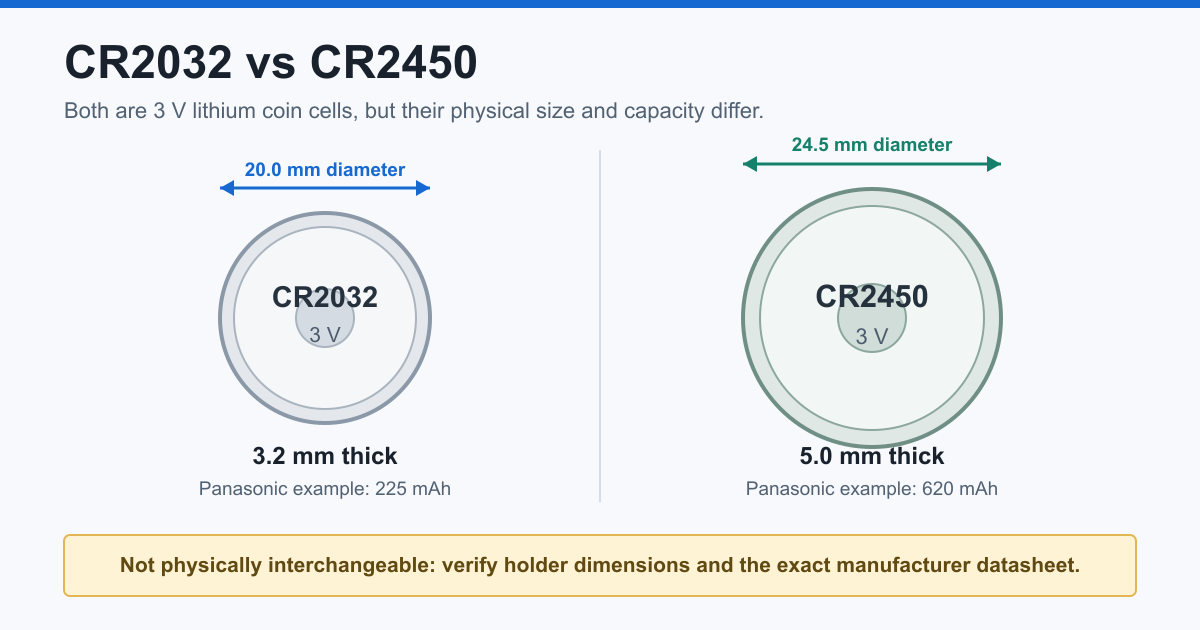
For current catalog examples, compare the Murata CR2032X and the Murata CR2450R. Both are listed under Dasenic's non-rechargeable primary battery catalog; verify the exact manufacturer datasheet, dimensions, terminal style and current stock before ordering.
CR2032 vs CR2450: Size and Capacity Comparison
| Specification | CR2032 | CR2450 |
|---|---|---|
| Diameter x height | 20.0mm x 3.2mm | 24.5mm x 5.0mm |
| Nominal voltage | 3V | 3V |
| Nominal capacity, Panasonic standard model | 225mAh | 620mAh |
| Standard drain, Panasonic standard model | 0.2mA | 0.2mA |
| Approximate weight, Panasonic standard model | 2.8g | 6.2g |
| Operating range, Panasonic standard model | -30 to +85 degrees C | -30 to +85 degrees C |
| Replacement requirement | Device approved for CR2032 | Device approved for CR2450 |
Sources: Panasonic's CR2032 specifications and CR2450 specifications. These example ratings do not describe every brand, high-drain series or terminal variant.
Physical fit comes first
The difference is not just thickness: CR2450 is also wider. A CR2032 holder does not become suitable for CR2450 because both cells say 3V. Check the battery compartment marking, device manual and original cell before ordering. A tabbed or wired assembly also requires the correct terminal arrangement; a bare coin cell is not automatically a replacement for it.
Capacity does not specify maximum current
The listed 0.2mA standard drain is a test/reference condition, not a universal maximum current rating. A device with short radio or motor pulses needs a cell whose discharge and pulse-load data meet that load. Do not infer continuous or pulse capability from capacity alone, and do not apply one manufacturer's high-drain rating to all cells of the same size.
Runtime and shelf life are different
There is no fixed number of years that either size lasts in every device. Runtime depends on average load, pulses, cutoff voltage, temperature and the usable capacity under those conditions. Dividing usable capacity by average current gives only an initial estimate. Storage time before installation is a separate question: follow the selected cell's storage guidance and date-code requirements.
Temperature, price and application
Compare temperature and discharge information for the exact ordering code. A standard cell, a high-drain series and a special-temperature variant may differ even when they share a size. Similarly, a larger battery is not automatically a higher-power battery. For purchasing, compare genuine like-for-like cells, quantity breaks, terminal options and current stock rather than assuming one size is always cheaper.
Are CR2450 and CR2032 Interchangeable?
Usually no. Their different diameters and heights require different holders and contact positions. A larger cell can fail to fit, while a smaller one can lose reliable contact. More capacity does not correct a mechanical mismatch or guarantee the required voltage under load.
Do not force a cell into the holder or improvise with loose spacers, foil or stacked cells. If a device explicitly supports more than one battery type, follow its manufacturer's instructions, including any approved holder or adapter. Otherwise replace the original with the specified format and verify polarity.
Can a CR2450 replace a CR2032 for longer life?
Not as a drop-in upgrade. A product designed around CR2032 needs its specified battery unless the manufacturer approves another arrangement. For a new design, compare holder space, load profile and supplier discharge curves before choosing a size. For an existing device, changing the battery format is a design change, not routine battery replacement.
Equivalent Names and Replacement Checks
A cross-reference or retailer's equivalent label is a starting point, not approval to substitute. Compare the original and proposed part using the manufacturer datasheets and the device requirements. The full ordering code matters, particularly for tabs, leads and special cell series.
- Dimensions and terminals: match diameter, thickness, polarity and contact or welded-tab layout.
- Electrical requirements: check chemistry, nominal voltage, operating voltage under load and the device cutoff.
- Load and environment: check continuous load, pulses and the intended temperature range.
- Charging: CR2032 and CR2450 are primary cells and must not be charged. Rechargeable ML or LIR cells require a device designed for that exact cell and charging method.
Do not treat BR2032 or BR2450 as automatic substitutes for their CR counterparts. Use them only when the device documentation or an engineering review supports the exact replacement. Other thickness codes, such as CR2016, CR2025, CR2430 or CR2477, are also not interchangeable merely because a listing groups them together.
CR2032 vs CR2450 FAQs
Which battery should I buy for my device?
Start with the model printed in the battery compartment or manual. Match the full cell specification and terminal style. If the original is missing or unreadable, identify the device's approved replacement rather than choosing from voltage alone.
Does CR2450 always last longer?
It generally offers more capacity in comparable product lines, but actual runtime still depends on the load and operating conditions. That does not make it a compatible upgrade for a CR2032 device.
Can I use a thinner coin cell temporarily?
Do not assume so. Different thicknesses change how the cell meets the contacts, and an improvised contact can be unreliable. Use only replacements and adapters that the device manufacturer approves.
Are CR2032 and CR2450 rechargeable?
No. Both are primary cells. Do not place them in a charger or replace them with a rechargeable type unless the product was specifically designed for that type.
How should I handle replacement cells?
Follow the manufacturer instructions, keep cells away from conductive objects and children, and do not mix old and new batteries. Secure the battery compartment after replacement. Use the product's specified storage and disposal guidance rather than a generic temperature or shelf-life claim.